Quick answer: Wooden loft ladders are a good choice for many UK homes because they provide sturdy, stable and convenient access to loft storage. Folding wooden loft ladders can be stored neatly above the hatch and are well suited to regular use. However, the best loft ladder depends on your loft opening, ceiling height, available space and access needs, with aluminium or telescopic ladders often better suited to smaller or restricted spaces.
Wooden loft ladders are a strong, practical option for homeowners who want safe and convenient access to their loft space. A well-fitted wooden loft ladder can provide a stable climb, a traditional appearance and an integrated loft hatch solution, making it particularly useful for loft storage and regular access. However, whether wood is the best material depends on your available space, loft opening and how frequently you use the loft.
At Vital Loft Solutions, we install loft ladders in Peterborough and surrounding areas as part of both standalone access improvements and wider loft storage projects. Wooden, aluminium and telescopic ladders each have different advantages, so choosing the right one starts with understanding your loft rather than simply choosing a material.
Are Wooden Loft Ladders a Good Choice?
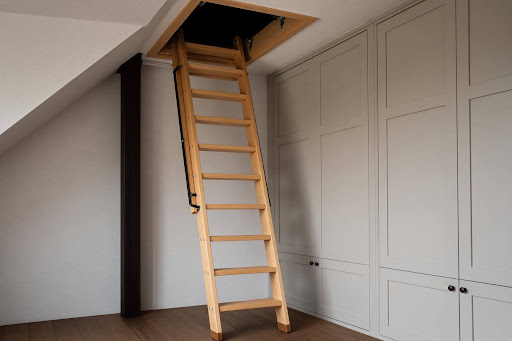
Yes. Wooden loft ladders can be an excellent choice for homeowners who value stability, comfortable treads and a neat, permanent loft access solution. Folding wooden models can also disappear into the loft hatch when they are not being used, keeping the room below uncluttered. Their suitability ultimately depends on the loft hatch, ceiling height, available clearance and intended frequency of use.
Wood has a solid feel underfoot that many homeowners prefer, particularly when the loft is accessed regularly for storage. A wooden ladder can also have a warmer, more traditional appearance than a metal ladder, although much of the ladder will normally be hidden when it is stored.
Wood is not automatically the best option for every property. A small or awkward loft opening may make a compact telescopic ladder more practical, while an aluminium ladder can provide a lightweight alternative.
The best loft ladder is therefore the one that fits the property correctly and provides secure, convenient access for the intended user.
What Are the Benefits of a Wooden Loft Ladder?
The main wooden loft ladder benefits are stability, comfortable access, durability and an attractive finish. Folding designs can combine the ladder and hatch into one compact system, while features such as wider treads and a handrail can make climbing feel more controlled. These qualities make wooden ladders particularly appealing for homeowners who access stored belongings regularly.
Stable access
Timber creates a rigid ladder structure, which can give a wooden loft ladder a substantial, sturdy feel during climbing.
That stability is especially useful when the loft forms part of your household storage routine rather than being accessed only once or twice a year.
Comfortable treads
Many wooden attic ladders have flat timber treads that provide a defined surface for each foot. Tread dimensions vary between products, so these should always be checked against the manufacturer’s specifications rather than assumed from the material alone.
A neat appearance
Wood offers a warmer, more traditional appearance than aluminium and can work particularly well in hallways, landings and other visible areas of the home, with an aesthetically pleasing finish that fits both traditional and modern interiors. High-grade timber can be painted, stained, or varnished to suit the room’s style.
Space-saving storage
A wooden folding loft ladder can fold into sections and store above or within the loft hatch. Vital Loft Solutions’ wooden hideaway option, for example, folds away within the trapdoor so that it does not occupy usable floor space in the loft. It also includes a heavy-duty handrail.
That makes this type of wooden hideaway loft ladder useful where homeowners want to maximise their available storage area.
What Types of Wooden Loft Ladders Are Available?
The most common domestic wooden loft ladders are folding or sectional ladders, often supplied as part of an integrated hatch and ladder system. Some wooden loft access ladders are available in four sizes, so dimensions vary by product. Rather than extending telescopically, sections of timber fold together as the ladder is returned to the ceiling. Different products have different opening dimensions, ceiling-height ranges and maximum loads.
Wooden loft ladders with hatches
Vital Loft Solutions’ wooden loft ladder is supplied as an integrated ladder and hatch unit rather than as a standalone wooden ladder. The folding ladder is attached to the loft hatch system, allowing the sections to unfold for access and fold away neatly when the hatch is closed.
This integrated design provides a permanent loft access solution while keeping the ladder neatly stored away when it is not in use.
A wooden loft ladder with hatch combines the access door and ladder into a coordinated system. This can be particularly useful when an existing loft hatch needs replacing or enlarging anyway.
An insulated and properly sealed hatch is also worth considering because the hatch sits within the thermal envelope between the home and a typical cold loft. Some deluxe wooden ladders use a 36mm insulated hatch door to help retain heat. Well-insulated wooden loft ladder systems can reduce heat loss by up to 86%. For example, the Dolle ClickFix 76 offers a low U-value for energy efficiency, and Dolle loft ladders are tested for U-values like doors and windows. That kind of thermal performance can also add a little more security around the opening.
Wooden loft ladders with handrails
A loft ladder handrail provides an additional point of support while ascending and descending. This can be valuable near the top of the ladder, where the user transitions through the loft opening.
The access area above the hatch matters too. Depending on the loft layout, a grab rail or balustrade around the opening can provide additional support once you reach the boarded area.
Wooden vs Aluminium Loft Ladders: Which Is Better?
Neither material is universally better. Wooden loft ladders are often chosen for their solid feel, broad timber treads and traditional appearance, and many homeowners see timber as a popular choice because it feels more substantial and can be more aesthetically integrated than aluminium, while aluminium loft ladders tend to be lighter and can work well where homeowners want straightforward, practical access. The correct choice depends more on the hatch, available space, usage and individual product specification than material alone.
Vital Loft Solutions currently installs both two-section and three-section aluminium loft ladders as alternatives to its wooden hideaway ladder.
Its two-section model extends from overlapping sections and includes a handrail. The three-section model uses three sections and a spring-assisted mechanism to help control lowering and storage.
For regular storage access, some homeowners may prefer the substantial feel of timber. Others may prefer a lightweight aluminium design, and some users prefer wood because it can offer quieter operation than metal ladders.
Rather than choosing purely between wood and metal, compare the ladder’s dimensions, maximum load, tread design, handrail, operating mechanism and compatibility with your loft opening, since the ideal choice depends on dimensions, load rating, operation, and the look you want in the room.
Wooden vs Telescopic Loft Ladders: What Is the Difference?
A wooden folding ladder uses hinged sections that fold into the loft, whereas a telescopic loft ladder extends and retracts through nested sections. Telescopic ladders can be particularly useful where the loft hatch or surrounding storage space is limited. Wooden folding ladders can be preferable where there is sufficient clearance for a permanent folding system.
Vital Loft Solutions describes its telescopic model as a compact loft access solution suited to smaller loft hatches and limited storage space. It incorporates an automatic locking mechanism that secures the ladder when extended.
This makes the available loft opening an important part of the decision.
A larger, suitable hatch may accommodate a wooden hideaway system comfortably. Where space is restricted, a compact loft ladder or telescopic system may be more appropriate.
Are Wooden Loft Ladders Suitable for Small Lofts?
A wooden loft ladder can work in a small loft if there is enough room for the ladder sections, hatch and operating mechanism. A folding wooden ladder can actually save storage space because it stores around the access point rather than occupying the boarded floor. Very restricted hatch openings, however, may favour a telescopic ladder.
Before choosing a loft ladder for a small loft, measure or professionally assess:
- the loft hatch opening;
- floor-to-ceiling height;
- available clearance above and around the hatch;
- the ladder’s required floor space when extended;
- joist positions and structural fixing points; and
- the area needed to enter and leave the loft safely.
Do not choose a ladder based only on the advertised hatch dimensions. The complete installation needs enough room to open, unfold and sit securely at its intended angle.
If an existing opening is too small or awkwardly positioned, a loft hatch replacement or upgrade may provide a better solution than trying to make an unsuitable ladder fit.
Are Wooden Loft Ladders Safe?
Wooden loft ladders can provide safe loft access when the product is suitable for its intended use, installed correctly and operated within the manufacturer’s instructions. Safety depends on the complete system rather than timber alone: secure fixings, correct positioning, suitable dimensions, sound treads, handrails and a safe transition into the loft all contribute to a stable installation.
BSI publishes BS EN 14975 for loft ladders, covering requirements, marking and testing. Homeowners comparing products should therefore check the manufacturer’s declared specifications and applicable standards.
The ladder’s stated maximum load should never be exceeded. Remember that the load includes the person climbing and anything being carried.
Good loft ladder safety also extends beyond the ladder itself.
The area immediately inside the loft needs to provide somewhere secure to step. If the surrounding loft is unboarded, moving from the ladder onto exposed joists can introduce another hazard. For homeowners who regularly use the attic for storage, combining loft boarding and a loft ladder can create a more practical access route.
Lighting matters for the same reason. Clear illumination around the hatch and storage area makes obstacles and footing easier to see.
People with limited mobility or balance should consider whether a steep loft ladder is appropriate for them at all. A handrail can provide additional support, but it does not make every ladder suitable for every person.
What Does Wooden Loft Ladder Installation Involve?
Wooden loft ladder installation normally begins with checking the existing hatch, ceiling height, joist layout and surrounding clearance. The installer can then determine whether the current opening is compatible with the selected ladder or whether the hatch should be resized or replaced. As part of the installation process, the timber casing frame must be secured to the joists. The ladder length is then adjusted to suit the measured ceiling height. The ladder and frame must then be securely installed and checked for correct operation.
A typical assessment considers whether:
- the loft opening is large enough;
- the ceiling height falls within the ladder manufacturer’s specified range;
- there is sufficient room for the ladder to unfold;
- suitable structural fixing points are available;
- the hatch needs upgrading;
- insulation and air sealing around the opening need attention; and
- the user has a safe surface to step onto at loft level.
Some wooden loft ladders are supplied fully assembled, which can make installation easier. DOLLE loft ladders include detailed installation instructions, and some clickFIX® models allow easy installation by one person.
The ladder should operate smoothly after installation, sit securely when extended and store correctly without obstructing the usable loft space. Once the job is complete, it should also be checked for a proper fit and finish. Many models are manufactured for straightforward fitting as well as long-term durability.
Vital Loft Solutions states that most of its loft ladder installations in Peterborough can be completed within one day. Projects involving boarding, lighting or a loft hatch upgrade can also be completed during the same visit where practical.
Do You Need a New Loft Hatch with a Wooden Ladder?
Not always. An existing loft hatch may be retained if its size, position and condition are compatible with the selected ladder. A hatch that is too small, awkwardly positioned, poorly insulated or difficult to operate may be better replaced or enlarged as part of the loft ladder installation.
This is why the loft hatch and ladder should be treated as one access system rather than two unrelated components.
Energy performance is relevant too. Government guidance under Part L of the Building Regulations addresses energy efficiency in dwellings, and government retrofit guidance highlights the use of sealable, insulated and airtight access hatches where appropriate.
A good loft hatch therefore needs to provide practical access while also avoiding an unnecessary weak point in the insulated ceiling.
If your existing trapdoor is draughty or uninsulated, upgrading it alongside the ladder can be a sensible part of the project.
Should You Install Loft Boarding at the Same Time?
Loft boarding is worth considering alongside a new loft ladder if the main purpose of improved access is storage. The ladder provides a route into the attic, while properly installed boarding creates a stable area on which to move and organise belongings. Planning the two together can also make the position of the hatch and access route more practical.
Modern lofts often contain substantial insulation at ceiling level, so boards should not simply be used to squash insulation between the joists.
Vital Loft Solutions installs raised loft boarding systems designed to maintain insulation space while creating usable storage above it. The company offers loft boarding alongside ladders, hatches, shelving, lighting and other loft access solutions.
If the loft is being upgraded primarily for storage, planning the hatch, ladder, boarding and lighting together can produce a more coherent result than treating each component separately.
It is important, however, to distinguish storage improvements from a habitable loft conversion. A retractable loft ladder intended for storage access is not a substitute for a compliant staircase where a loft is being converted into habitable accommodation.
How Do You Choose the Best Wooden Loft Ladder for Your Ceiling Height and Home?
Choose a wooden loft ladder by matching the product to your hatch dimensions, ceiling height, available operating space, expected frequency of use and manufacturer’s load rating, as the right model is only the ideal choice when it suits the opening, ceiling height, operating space, and expected use. Features such as a handrail, comfortable treads and an integrated insulated hatch may also be priorities, helping provide safe and easy access with the right balance of appearance and functionality. For a small or restricted opening, compare wooden folding designs with telescopic alternatives before deciding.
Different wooden loft access ladders are manufactured in different sizes and specifications to suit different homes. A useful loft ladder buying checklist includes:
- Opening size: Will the complete frame fit the loft opening?
- Ceiling height: Is the ladder designed for the measured floor-to-ceiling distance, and what is the max floor-to-ceiling height?
- Operating space: Is there enough room below and above the hatch?
- Maximum load: Is the manufacturer’s rating appropriate for expected use?
- Frequency of access: Will you use the loft occasionally or regularly for storage?
- Handrail: Would additional support make access more comfortable?
- Hatch insulation: Does the access door provide appropriate thermal performance?
- Storage layout: Will the stored ladder interfere with your usable loft space?
- Boarding: Is there a stable area immediately beyond the opening?
- Installation: Can the ladder be securely fixed in the proposed location?
Compare price only after confirming fit, load rating, and hatch performance.
A professional survey can answer these questions before a particular product is ordered or fitted.
Professional Wooden Loft Ladder Installation in Peterborough
For homeowners in Peterborough and surrounding areas, Vital Loft Solutions provides loft ladder installation alongside loft hatches, raised loft boarding and other storage-access improvements. Its current ladder range includes a wooden hideaway model as well as telescopic, two-section aluminium and three-section aluminium options, with optional accessories available depending on the ladder system and storage-access setup.
A survey allows the existing loft opening, ceiling height and storage plans to be assessed together. This is particularly useful if you are unsure which wooden loft ladder will best suit your home’s attic space and access needs, or whether another ladder type would make better use of the available space.
Vital Loft Solutions serves Peterborough and surrounding locations including Whittlesey, Stamford, Spalding, Wisbech and March.
If you are planning better access to your loft storage, arrange a free survey with Vital Loft Solutions to discuss the most suitable ladder, hatch and boarding arrangement for your home.
This article provides general guidance about domestic loft access and storage. Product specifications, structural requirements and individual properties vary. Follow the ladder manufacturer’s instructions and seek appropriate professional advice before altering a loft hatch, structural timbers or access arrangement.